



Money and Computing
Jo Freeman: There’s Plenty To Do at the RNC – If You Have the Right Credentials
by Jo Freeman
Every national nominating convention has plenty of auxiliary events, some authorized, some not. Getting space can be a challenge; getting the word out even more so. But they do it nonetheless. Press were given a RNC 2024 Master Event Calendar, which was updated a few days later. Events began on Sunday and ended on Thursday. The actual convention sessions were just one item on the list. The calendar said if an event was Open or Closed to press, and also whom to contact to register. I’m going to describe some of the events, including a couple I went to, and a couple I was turned away from.
Since my focus is on women, I obviously wanted to go to those events – if I could.
The National Federation of Republican Women is the largest grassroots Republican women's organization in the country with hundreds of clubs. Founded in 1938, its members made the phone calls and knocked on the doors that elected Republican candidates for decades. It’s Tuesday luncheon featured Arkansas Governor Sarah Sanders. The Master Calendar said it was SOLD OUT and they wouldn’t let me in. I was able to get into their lounge at the Fiserv Forum Wednesday evening, where I was repeatedly asked if I was a member, and if not, would I join. “I’m press,” I said. “I can’t join anything partisan.” I then said: “What brings you here?” On hearing that, finding anyone willing to chat with me was like pulling teeth.
Moms for Liberty met in a concert hall that afternoon. I had pre-registered, and I got in. From high in a balcony seat I listened to several people talk about the evils of transgenderism. It’s webpage says WE BELIEVE Power Belongs to the People. Sound Familiar? With a focus is on parental rights, it wants to “STOP WOKE indoctrination.”
Tuesday I went to “The New Mavericks” reception co-hosted by the Black Republican Mayors Association and the Georgia Republican Party. They honored Sen. Tim Scott, four Congressmen and two Georgia delegates – all male. There was only one mayor on stage, from Aurora, IL. The chair of the Georgia Republican Party was the one white man on the stage. At that event, women served; they didn’t speak. The RNC reported that 55 delegates to the 2024 convention are Black, up from 18 in 2016.
I missed the Independent Women’s Forum toast to “Women Who Make Our Country Great” because I went to Convention Fest: The Official Delegate Experience, which was held in the streets outside the Fiserve Forum and Baird Hall as well as some space inside Baird. To get to that one you not only needed a credential of some sort, but a USSS pass (which I have).
Concerned Women for America parked its pink bus across from the Baird Center the week before the RNC. No one was home. When Convention Fest opened on Tuesday afternoon, they set up a pink tent, from which its leaders preached to whomever passed by. It calls itself “the nation’s largest public policy women’s organization” but its focus is evangelical Christian. The slogan on the side of its pink bus captures this emphasis: “She Prays, She Votes.” A prayer precedes each sermon.
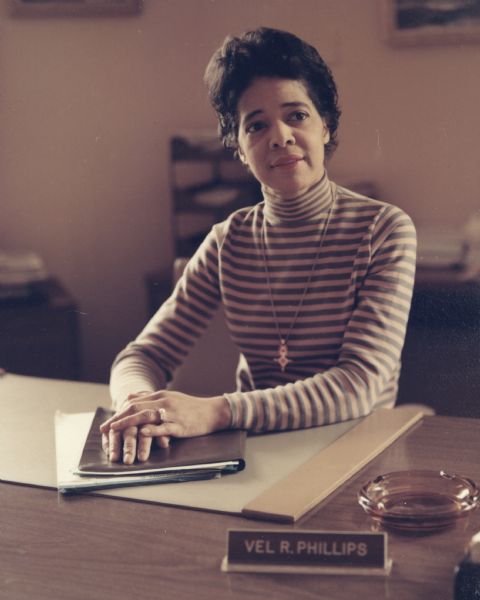 Milwaukee’s Civil Rights Legacy by Jo Freeman
"One street is named Vel R. Phillips Ave. A Milwaukee native, she was a multiple first. The first Black woman who: graduated from U. Wisconsin Law School, elected to the city council, judge, elected Secretary of State, served on the Democratic National Committee. She was also active in the NAACP, leading open housing marches and getting arrested. Shortly after she died in 2018, N. 4th St. was renamed in her honor. That’s why the official address of the Fiserv Forum, where the Republican convention was held July 15-18, is 1111 N. Vel R. Phillips Ave... As I walked the streets of Milwaukee, viewing some elegant old churches, I thought about its civil rights legacy." more »
 Women's Congressional Policy Institute; Weekly Legislative Update, July 22, 2024; Rural Development, Food and Drug Administration, Agriculture, Nutrition Assistance, Child Care, Women-owned Business Programs at the Small Business Administration.
Bringing women policymakers together across party lines to advance issues of importance to women and their families. Congressional Schedule: July 22-26, 2024. Weekly Legislative Update. This week, the House is scheduled to consider H.R. 8998, the FY2025 Interior, Environment, and Related Agencies spending bill. The legislation includes funding for the Smithsonian American Women’s History Museum. Also this week, the House is scheduled to consider H.R. 8773, the FY2025 Financial Services and General Government spending bill. The legislation includes funding for women-owned business programs at the Small Business Administration. more »
 Security at the RNC By Jo Freeman: My Second Dispatch From The Republican NC
"Even with pre-convention credentials, some places are closed. The North building of the Baird Center is open to press. The South Building is not. I was turned away completely before getting my pre-convention credentials. Once they were hanging from my neck, security let me in. I discovered that the convention committees (Platform, Bylaws, Credentials) were meeting in that side of the Baird Center. But they were closed to press. Indeed on my way out, when I happened to mention to the two Security guards that I wrote for a small online magazine, they told me that I wasn’t allowed into the South building at all. They let me in initially because I don’t look like press and they thought I was one of many volunteers."
more »


